Posts

Image
We have an article in the Photographic Society of American Journal for July 2023 with lots of images and information on our work to date. PSA is a world-wide organization of photographers of all genres so we are happy that they have chosen us for their cover.  You can read the article at:  https://cdn.ymaws.com/psa-photo.org/resource/resmgr/pdf/journal_/2023/2023-07-psa-journal.pdf  

Greater Prairie Chicken Photography Workshop Just Announced

Image
  Greater Prairie Chicken Photography Workshop Just Announced! OK, we don't want to hog all the fun. Here is your chance to photograph these crazy fast, fun and explosive birds on their mating lek. Join Sandy in April 2024 and learn all about Greater Prairie Chicken behavior and the photo techniques it takes to capture these challenging birds.  Click HERE and find all the details. Hope to see you there! Below is a sampling of what is possible.

Greater Prairie Chickens Booming on the Lek

Image
Photo credit: David Bates Early morning in mid-April found us on a Colorado mating lek of a pack of Greater Prairie Chickens ( Tympanuchus cupido) . There is something special about the busyness and noises of the lek that keeps us coming back in the springtime. Listen to the booming sounds and clucking of the prairie chickens as you watch this early morning video. You might even hear the pounding of their feet as the males prepare to fill their gular sacs, bow, and boom. Yes, Greater Prairie Chickens (GPC) do fly.  Not only are they prolific jumpers and sparing experts, but they can also fly at speeds of up to 50 mph, as we saw when it was time for them to leave the mating lek.  Like other grouse we have seen, the GPC leave the lek in a pack and seemingly all at once, maybe upon the signal of a lead GPC, though that is not always evident. They will leave the lek temporarily, if they suspect danger lurks such as a circling hawk or a prowling coyote.  Once the perceived dan...

Here We Go Again!

Image
It's BREEDING SEASON on the prairie again! Christine and I, creators of Chicks on a Grouse Trip , are back at it and have plans to be there for the action. Thanks for joining us for another year of grouse blogging!  This year you'll find us on the plains in the state of Colorado searching for Greater Prairie Chickens ( Tympanuchus cupido ). Similar but different from the Lesser Prairie Chickens ( Tympanuchus pallidicinctus ) we photographed in Kansas in 2022.  Note : the image above is a Lesser PC taken in Kansas as we later realized we did not photograph Greater PC's in 2022. Watch for future posts with images of Greater PC's from the field and follow our latest adventures. It is so much easier to identify birds during breeding season, especially male birds, as most birders and bird photographers know. So descriptions in this article address male features and behaviors. The two prairie chicken species are hardly discernible without their air sac exposed. Greater PC...

Photographing Sharpies at a Lek

Image
                                                            (First kiss of sunlight before I changed camera settings, ISO 12,800, f4, 1/640, male STG strutting, not cropped) Originally I was going to share my thoughts on photographing multiple species of grouse while on their lek but once I started compiling notes (and images) I thought better of it and decided to write about one species at a time and in this post it will be the sharp-tailed grouse, aka "sharpies" or known by the acronym STG.  After photographing STG on a couple leks during our 2022 adventure, I can say they are not the highest jumpers. What does that mean? Compared to the greater and lesser prairie chickens, the chickens win. Their fights reached further off the ground and seem to explode in the air high enough to clear most gr...

Ethical Wildlife Photography

Image
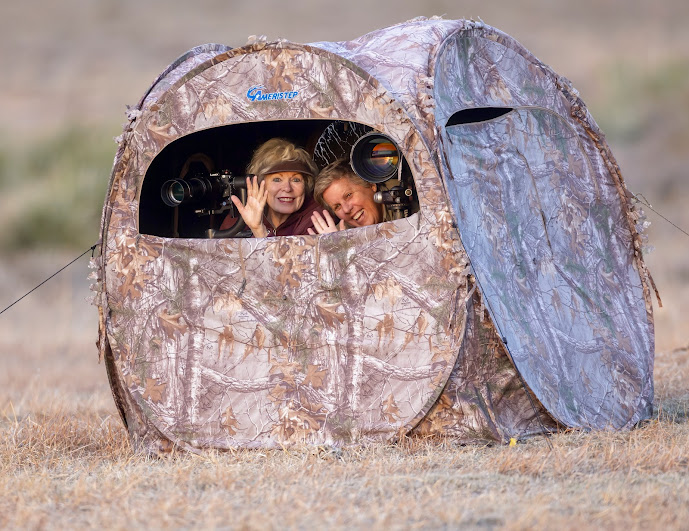
Ethics on a lek. It should go without saying. When photographing wildlife anywhere, it is imperative to be mindful of your presence and how it might affect your subject(s) and/or situation you are wishing to photograph. As photographers, we are of course documenting a behavior or telling a story the best we can. Lets tell the ethical story. An animal's welfare should never be compromised.  When photographing at a lek there are specific and important guidelines to follow. If I may quote Jackie Augustine, Executive Director of Audubon of Kansas, "If your behavior is modifying what the birds are doing, then don't do it." She also adds, common ways to disturb birds include: 1) placing a blind too close to a lek, 2) having long lenses sick out of the blind and/or moving fast, 3) leaving the blind before the birds leave the lek, and 4) noisy cameras when winds are calm.   Trespassing is to be avoided. Do not step foot off a public roadway and onto a farmers land (including ...

Breeding Season for Birds on the Prairie

Image
Like with most bird species, Spring is the season!  The action begins in late March and lasts throughout April with offspring hatching after approximately 23-26 days. Females typically lay anywhere from 7-17 eggs in tall, dense grass and on the ground under sagebrush. Only one or two dominant males at a lek usually procure most of the mating opportunities. In the case of prairie chicken males, they stomp their feet rapidly or “dance” to attract females. Greater sage grouse show off in a booming, "strutting" courtship display somewhat different from sharp tail grouse and lesser or greater prairie chickens. But all males fight off other males to show dominance for the chance to breed and defend their territory. Plan your visit accordingly. In our experience, the earlier in the season the better.